9/16/15 ***See information on this post on my new website at https://artsintersection.wordpress.com/2015/09/16/floor-staff-strategy-for-teaching-sol-and-mi/
1st grade has been practicing the pitches "so" and "mi" (high and low). We read the book "Brown Bear, Brown Bear, What Do You See?" After some practice composing so-mi pitches for the words of the book as a class and singing them, we split into groups to compose our own animal melodies. We used Zoo Pal plates on 2-line staffs taped to the floor of the music room, and some of us even earned "I Sang By Myself" certificates for singing their compositions for the class! See our work below!
Sunday, February 24, 2013
Kindergarten High and Low on Instruments!
"Small is high,
Big is low.
That is science
we should know!"
Kindergartners learned this poem for our first composition activity on the Orff instruments. We learned that small instruments and small bars make high sounds, and big instruments and big bars make low sounds.
We read the book "Brown Bear, Brown Bear, What Do You See?" After reading, we assigned high and low pitches to the words of the book. We sang our composition, and then went to the instruments and spent some time using our knowledge of high/low instrument bars and high/low sounds to figure out how to play our composition.
4th Grade February Recap: Chords and Ballads
4th grade has been quite busy! We've been exploring several different musical topics and they've been intersecting in different ways!
We learned about how to build chords. A chord is a combination of 2 or more notes being played at the same time. We have learned how to build triads (1-3-5) based on chord symbols, and played chords on Boomwhackers and bass bars along with the song "Love Somebody" (which also taught us about the pitch "fa"). Soon, we'll be learning about I-V chord progressions.
We have also been doing some cross-curricular learning about ballads. 4th grade has been learning about ballads with their classroom teachers, so this seemed like a natural point of integration because ballads can be poems or songs! We read The Edmund Fitzgerald: The Song of the Bell. We then listened to Gordon Lightfoot's "The Wreck of the Edmund Fitzgerald," identified chord changes, and then built and played chordal accompaniment along with the song.
That's just a bit of what we've been up to! We've also been continuing our learning about opera, so stay tuned for information about our study of both opera seria and opera buffa!
We learned about how to build chords. A chord is a combination of 2 or more notes being played at the same time. We have learned how to build triads (1-3-5) based on chord symbols, and played chords on Boomwhackers and bass bars along with the song "Love Somebody" (which also taught us about the pitch "fa"). Soon, we'll be learning about I-V chord progressions.
We have also been doing some cross-curricular learning about ballads. 4th grade has been learning about ballads with their classroom teachers, so this seemed like a natural point of integration because ballads can be poems or songs! We read The Edmund Fitzgerald: The Song of the Bell. We then listened to Gordon Lightfoot's "The Wreck of the Edmund Fitzgerald," identified chord changes, and then built and played chordal accompaniment along with the song.
That's just a bit of what we've been up to! We've also been continuing our learning about opera, so stay tuned for information about our study of both opera seria and opera buffa!
Wednesday, February 6, 2013
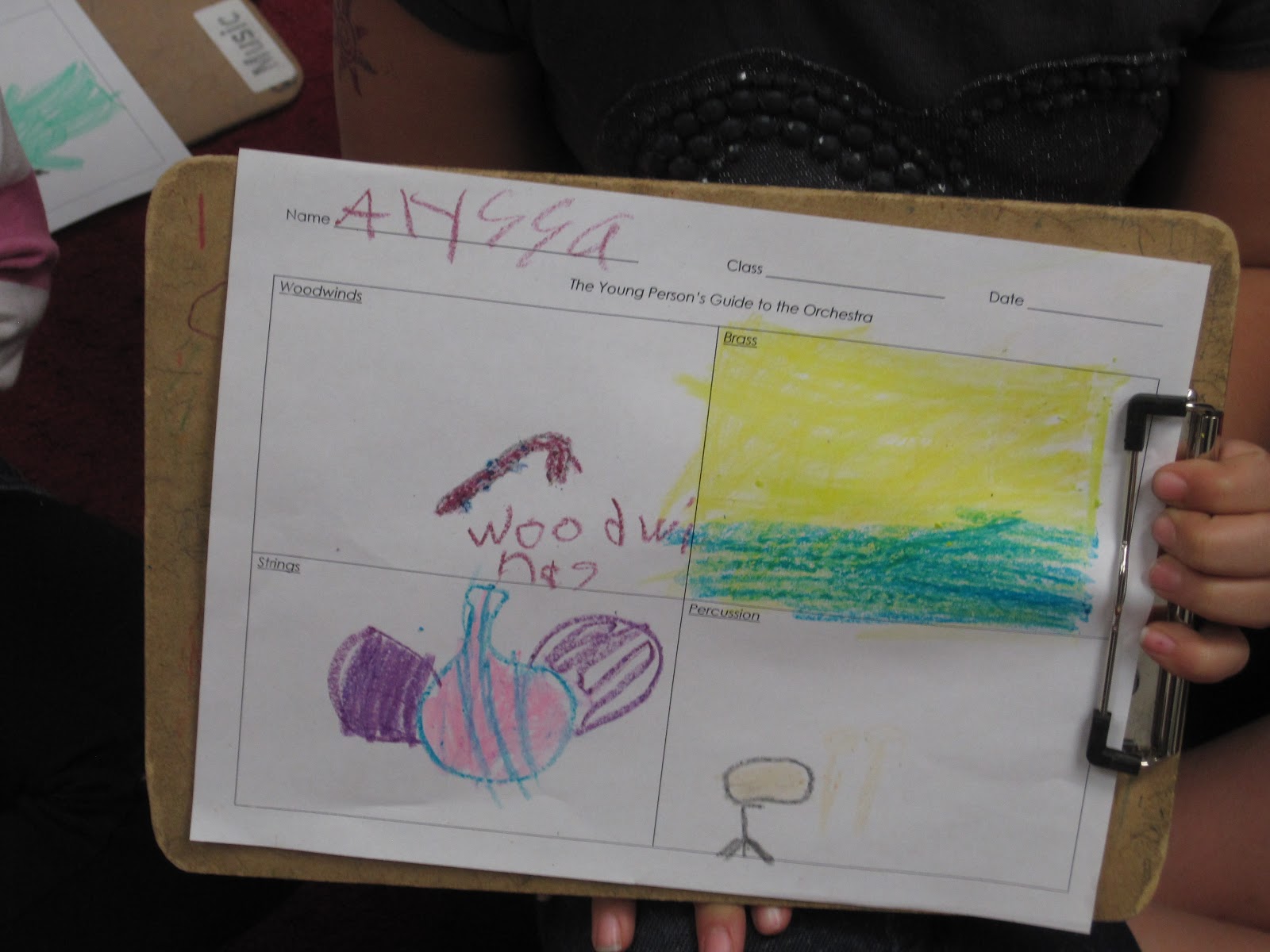
Instrument Families and "The Young Person's Guide to the Orchestra"
2nd grade has been learning about families of instruments in the orchestra: strings, woodwinds, brass, and percussion. We listened to Benjamin Britten's "Young Person's Guide to the Orchestra," which features each family as well as the orchestra as a whole. First, we listened and followed a listening map. Next, we used our imaginations to come up with pictures, images, words, moods, etc. that each family reminded us of, and we put those images on paper. This reinforced the "voice" of each family so that we could more readily recall what each family sounded like in our next activity.
We assigned colors to each family of the orchestra (green, red, yellow, and blue), and each student was assigned a flashlight that shines one of those colors. We then listened to our piece of music and created a light show by recognizing each family's sound and shining our flashlights on the ceiling when we heard our "color."
Wednesday, January 23, 2013
Kindergarten- High, Middle, and Low Video!
9/2/15***SEE MY NEW WEBSITE AT https://artsintersection.wordpress.com/2015/09/02/teaching-high-and-low-faeries-and-giants/***
This morning, kindergarten learned a little bit about high, middle, and low sounds. We played some SMART Board games, and we watched this great Sesame Street video featuring high, middle, and low voices.
Stay tuned! Next week, we'll be putting our knowledge of high and low into practice on the instruments, as well as reading a new book and composing our own high and low melodies!
This morning, kindergarten learned a little bit about high, middle, and low sounds. We played some SMART Board games, and we watched this great Sesame Street video featuring high, middle, and low voices.
Stay tuned! Next week, we'll be putting our knowledge of high and low into practice on the instruments, as well as reading a new book and composing our own high and low melodies!
Friday, January 18, 2013
5th Grade Drumming Finale!
The 5th graders have finished up their world drumming unit. In this unit, we were working on:
- Using correct hand technique (alternating hands).
- Playing steady and consistent rhythms.
- Maintaining independence from other musical parts.
- Interacting with a group (watching and being aware of others).
- Maintaining focus and concentration within the ensemble.
- Playing with good posture.
- Listening to others while playing our own parts.
Friday, January 11, 2013
Half Note Fun
2nd grade has been learning a new rhythm- half notes (worth 2 beats). We learned a new song called "Donkey, Donkey" (some of us are very excited to be singing about donkeys, which we apparently love). We learned to read this new rhythm, and then we composed eighth/quarter/half note rhythm patterns in an unconventional way- with Play Doh! Each student received a "beat bar" with 4 beats, and had to create a 4-beat pattern using quarter notes (notated by 1 "blob" of Play Doh on the beat), eighth notes (2 blobs sharing the same beat), and half notes (1 giant blob that spreads through 2 beats). I think we enjoyed our hands-on experience and this new way of composing!
We've now starting learning some instrumental accompaniment for the song, so we'll be practicing playing our new half note rhythms, so stay tuned for videos of in-class performances!
Subscribe to:
Posts (Atom)