Showing posts with label Composition. Show all posts

Tuesday, May 21, 2013

One last round of centers for 2nd grade!


1/18/16***See my new website and check out the blog post on Crazy Cube compositions at https://artsintersection.wordpress.com/2016/01/18/composition-cubes/

We thought we'd try to squeeze in one last round of centers before we leave for the summer!

2nd grade has been learning about the pitch "re" through songs and activities, and now they are off exploring this concept in our centers!

In the reading center, we are playing some SMART Board games to match up written melodic patterns with what we hear and what we see.


In the writing center, we are using melodic crazy cubes with pentatonic pitches (do, re, mi, so, and la) to compose our own piece of music to a given rhythm.


In the listening center, students are listening to "Carillon" by Georges Bizet. This song features a "mi-re-do" ostinato that we have listened to in class. Students are completing a graphic organizer based on their listening and writing a paragraph about what they heard.


In the games center, we are playing Candyland! Not just regular Candyland, mind you, but musical Candyland! When students draw a card to move forward, they then have to draw a musical challenge color-coded to match their card. They may have to sing something, answer a question, read a rhythm, or any number of musical tasks. I think it's safe to say that this is a favorite.


And finally, in the instrument center, students are using what they know of "mi, re, and do" to figure out how to play simple melodies on Orff instruments. They are learning to play "Hot Cross Buns" and "Let Us Chase the Squirrel."

Sunday, February 24, 2013

1st Grade So-Mi Composition

9/16/15 ***See information on this post on my new website at https://artsintersection.wordpress.com/2015/09/16/floor-staff-strategy-for-teaching-sol-and-mi/


1st grade has been practicing the pitches "so" and "mi" (high and low). We read the book "Brown Bear, Brown Bear, What Do You See?" After some practice composing so-mi pitches for the words of the book as a class and singing them, we split into groups to compose our own animal melodies. We used Zoo Pal plates on 2-line staffs taped to the floor of the music room, and some of us even earned "I Sang By Myself" certificates for singing their compositions for the class! See our work below!


Kindergarten High and Low on Instruments!

"Small is high,
Big is low.
That is science
we should know!"

Kindergartners learned this poem for our first composition activity on the Orff instruments. We learned that small instruments and small bars make high sounds, and big instruments and big bars make low sounds.

We read the book "Brown Bear, Brown Bear, What Do You See?" After reading, we assigned high and low pitches to the words of the book. We sang our composition, and then went to the instruments and spent some time using our knowledge of high/low instrument bars and high/low sounds to figure out how to play our composition.


Friday, January 18, 2013

5th Grade Drumming Finale!

The 5th graders have finished up their world drumming unit. In this unit, we were working on:
  • Using correct hand technique (alternating hands).
  • Playing steady and consistent rhythms.
  • Maintaining independence from other musical parts.
  • Interacting with a group (watching and being aware of others).
  • Maintaining focus and concentration within the ensemble.
  • Playing with good posture.
  • Listening to others while playing our own parts.
We've learned some strategies for creating patterns within a drum circle, for improvising, and for being spontaneously musically creative within the structure of an ensemble. We wrapped up our big group experience by splitting up into small ensembles, composing rhythmic patterns, and performing them for the class. See us at work below!


Wednesday, December 12, 2012

2nd Grade Centers

***See post on cottonball compositions at my new website: https://artsintersection.wordpress.com/2015/12/10/free-tpt-resource-cottonball-compositions/***

In 2nd grade centers, we've been focused on reviewing quarter note, quarter rest, and eighth note rhythms, as well as reinforcing our knowledge and use of the pitches mi, so, and la.

In the red (reading) center, we've been working on matching up melodic shapes with familiar tunes we hear on the SMART Board in an activity called "Caroler Puzzles." Basically, we're looking at a melodic shape, listening to two familiar holiday tunes, and deciding which one matches based on the direction of the melody.

In the green (writing) center, we are identifying la on the staff, and then we are composing mi-so-la melodies in a fun way- by playing Rock, Paper, Scissors! Students are partnering up to play, and if rock wins, both students write mi on the staff, if paper wins, both students write so on the staff, and if scissors wins, both students write la on the staff. Then we play until we've composed an 8-beat melody.

In the listening center, we are listening to "Russian Dance" from The Nutcracker and filling out our Gingerbread Listening Glyphs based on what we heard.

In the purple (game) center, students are playing Zap It! Students pass a cup of popsicle sticks around the circle, and each student pulls out a stick. On the stick is written a rhythm, which the student has to read. If they read it correctly, they keep the stick. If they read it incorrectly, they put the stick back in teh cup. If the student pulls the "Zap It" stick, he or she must put all of their sticks back in the cup. The person with the most sticks at the end of the game wins!


In the yellow (instrument) center, students are using cottonballs to compose mi-so-la melodies on a two-line staff and playing them on glockenspiels.


Also, a HUGE thank you to the parent volunteers who have come in to help facilitate centers- your help has been invaluable!!!

3rd Grade Centers

3rd grade centers are almost wrapped up! Here's what we've been up to...

We've been working at the SMART Board on rhythmic note identification and even some rhythmic math (adding note values).

In the green (writing) center, we've been working on a rhythmic composition including quarter notes, eighth notes, half notes, quarter rests, and half rests. Soon, we'll be performing our compositions!
In the listening center, we've been listening to "Dance of the Sugar Plum Fairy" from The Nutcracker and completing listening logs based on what we hear.


In the purple (games) center, we've been playing Smack It! (pictures coming soon!) When we play Smack It, we review the note names for lines and spaces of the treble clef. Then, with one person calling out note names, we compete to see who can smack their bean bag down on the correct line or space. This gets intense!

And finally, we are playing our beloved recorders in the yellow (instrument) center. We're reviewing the main rules of playing the recorder (left hand on top, cover the holes completely, whisper warm air, and think "too"). Then, we are playing the note B in many different exercises, and even improvising some rhythms on the note B.


Thanks for stopping by!


Monday, December 10, 2012

Centers in full swing!

Students in 1st through 4th grade music classes are rotating through musical centers during the month of December. Each center is designed to allow students to explore musical concepts through different means, whether it be by writing, reading, playing, or listening.

We'll start with 4th grade.

The first activity is a music & math activity called "Snowflake Shootout" on the SMART Board, in which students work to identify rhythmic notation and their values.


Next, students travel to the "Jug Band" performance station, where they perform rhythms they have previously written on the xylophone. Their rhythm compositions include quarter notes, eighth notes, sixteenth notes, and eighth-sixteenth combinations.


In the listening center, students are using iPods to listen to "Dance of the Sugar Plum Fairy" from The Nutcracker. After listening to the song and following key elements of the music on a listening map, students complete a listening log about what they heard.


Have you ever played "Don't Break the Ice?" We have! We're playing a musical version of the game, in which rhythms are written on the ice cubes. Before knocking out a cube, students have to read the rhythm in the row. After knocking it out, students replace that rhythm with a rest.


And finally, recorders are back. Students are reviewing the notes B, A, and G on the recorders in several written exercises. Soon, we'll be improvising our own B-A-G melodies.


Friday, October 5, 2012

2nd Grade September-in-Review

1/18/16***See my new website at check out the post on Composition Cubes at https://artsintersection.wordpress.com/2016/01/18/composition-cubes/


September 20, 2012: Crazy Cube Compositions
We're composing! Students are using "crazy cubes" (which are really just actually wooden blocks with quarter note, eighth note, and quarter rest rhythms drawn on them) to compose a 16-beat rhythm piece. Students roll 4 cubes at a time, arrange their rhythm how they want with the 4 rhythms showing, and copy it onto the composition worksheet. After four rounds of this, we've got a 16-beat composition! The kids will take some time to practice their rhythm composition and will soon be performing them on instruments!


September 11, 2012
We're now moving onto another song using those quarter note, eighth note, and quarter rest rhythm patterns. The song is "I Bought Me a Cat" by the American composer Aaron Copland. Here is a video performance of the song similar to the version we listened to in class.

          I Bought Me a Cat

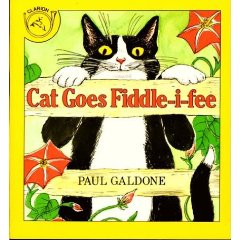
We'll soon be adding instrumentation to this song to create our own performance, and we'll work on our music literacy by matching each "animal sound" to corresponding rhythm patterns. We'll also explore extra verses by reading the book "Cat Goes Fiddle-i-Fee" by Paul Galdone (click on title for the Glen Ellyn library's listing for this book).


September 6, 2012: Step in Time
We've started out the school year by reviewing quarter note, eighth note, and quarter rest rhythms. We've been learning the song "Step in Time" (from Mary Poppins) and learning how follow along with a vocal score, reading repeat signs, and first and second endings. We also had fun creating movements to show a steady beat with each verse.


Here is a link to the scene from "Mary Poppins!"

          Step in Time