Showing posts with label Listening. Show all posts

Wednesday, February 6, 2013

Instrument Families and "The Young Person's Guide to the Orchestra"

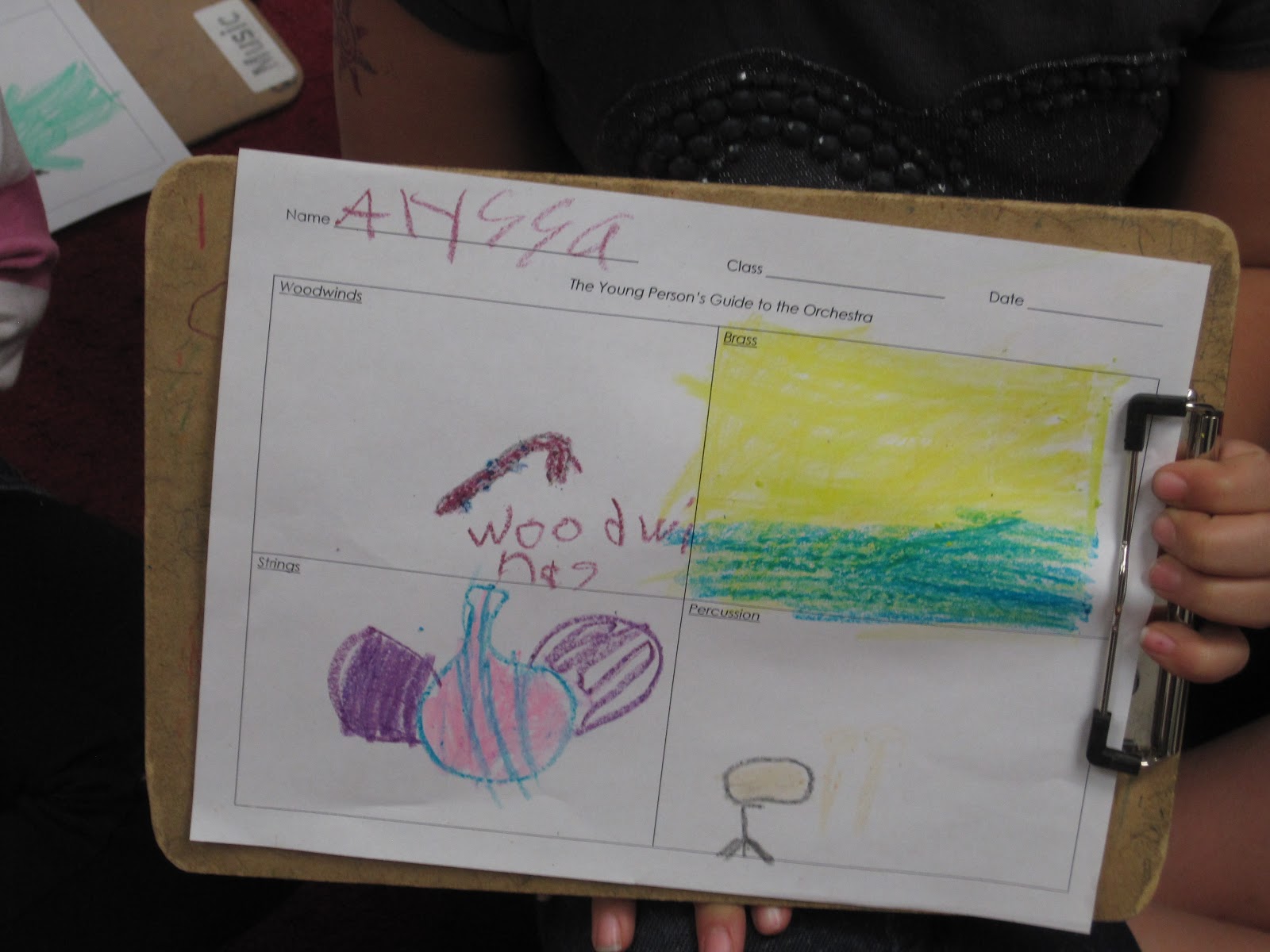
2nd grade has been learning about families of instruments in the orchestra: strings, woodwinds, brass, and percussion. We listened to Benjamin Britten's "Young Person's Guide to the Orchestra," which features each family as well as the orchestra as a whole. First, we listened and followed a listening map. Next, we used our imaginations to come up with pictures, images, words, moods, etc. that each family reminded us of, and we put those images on paper. This reinforced the "voice" of each family so that we could more readily recall what each family sounded like in our next activity.

We assigned colors to each family of the orchestra (green, red, yellow, and blue), and each student was assigned a flashlight that shines one of those colors. We then listened to our piece of music and created a light show by recognizing each family's sound and shining our flashlights on the ceiling when we heard our "color."


Wednesday, December 12, 2012

2nd Grade Centers

***See post on cottonball compositions at my new website: https://artsintersection.wordpress.com/2015/12/10/free-tpt-resource-cottonball-compositions/***

In 2nd grade centers, we've been focused on reviewing quarter note, quarter rest, and eighth note rhythms, as well as reinforcing our knowledge and use of the pitches mi, so, and la.

In the red (reading) center, we've been working on matching up melodic shapes with familiar tunes we hear on the SMART Board in an activity called "Caroler Puzzles." Basically, we're looking at a melodic shape, listening to two familiar holiday tunes, and deciding which one matches based on the direction of the melody.

In the green (writing) center, we are identifying la on the staff, and then we are composing mi-so-la melodies in a fun way- by playing Rock, Paper, Scissors! Students are partnering up to play, and if rock wins, both students write mi on the staff, if paper wins, both students write so on the staff, and if scissors wins, both students write la on the staff. Then we play until we've composed an 8-beat melody.

In the listening center, we are listening to "Russian Dance" from The Nutcracker and filling out our Gingerbread Listening Glyphs based on what we heard.

In the purple (game) center, students are playing Zap It! Students pass a cup of popsicle sticks around the circle, and each student pulls out a stick. On the stick is written a rhythm, which the student has to read. If they read it correctly, they keep the stick. If they read it incorrectly, they put the stick back in teh cup. If the student pulls the "Zap It" stick, he or she must put all of their sticks back in the cup. The person with the most sticks at the end of the game wins!


In the yellow (instrument) center, students are using cottonballs to compose mi-so-la melodies on a two-line staff and playing them on glockenspiels.


Also, a HUGE thank you to the parent volunteers who have come in to help facilitate centers- your help has been invaluable!!!

3rd Grade Centers

3rd grade centers are almost wrapped up! Here's what we've been up to...

We've been working at the SMART Board on rhythmic note identification and even some rhythmic math (adding note values).

In the green (writing) center, we've been working on a rhythmic composition including quarter notes, eighth notes, half notes, quarter rests, and half rests. Soon, we'll be performing our compositions!
In the listening center, we've been listening to "Dance of the Sugar Plum Fairy" from The Nutcracker and completing listening logs based on what we hear.


In the purple (games) center, we've been playing Smack It! (pictures coming soon!) When we play Smack It, we review the note names for lines and spaces of the treble clef. Then, with one person calling out note names, we compete to see who can smack their bean bag down on the correct line or space. This gets intense!

And finally, we are playing our beloved recorders in the yellow (instrument) center. We're reviewing the main rules of playing the recorder (left hand on top, cover the holes completely, whisper warm air, and think "too"). Then, we are playing the note B in many different exercises, and even improvising some rhythms on the note B.


Thanks for stopping by!


Monday, December 10, 2012

Centers in full swing!

Students in 1st through 4th grade music classes are rotating through musical centers during the month of December. Each center is designed to allow students to explore musical concepts through different means, whether it be by writing, reading, playing, or listening.

We'll start with 4th grade.

The first activity is a music & math activity called "Snowflake Shootout" on the SMART Board, in which students work to identify rhythmic notation and their values.


Next, students travel to the "Jug Band" performance station, where they perform rhythms they have previously written on the xylophone. Their rhythm compositions include quarter notes, eighth notes, sixteenth notes, and eighth-sixteenth combinations.


In the listening center, students are using iPods to listen to "Dance of the Sugar Plum Fairy" from The Nutcracker. After listening to the song and following key elements of the music on a listening map, students complete a listening log about what they heard.


Have you ever played "Don't Break the Ice?" We have! We're playing a musical version of the game, in which rhythms are written on the ice cubes. Before knocking out a cube, students have to read the rhythm in the row. After knocking it out, students replace that rhythm with a rest.


And finally, recorders are back. Students are reviewing the notes B, A, and G on the recorders in several written exercises. Soon, we'll be improvising our own B-A-G melodies.


Wednesday, October 10, 2012

3rd Grade September-in-Review


Peter and the Wolf
We reviewed Sergei Prokofiev's Peter and the Wolf to familiarize ourselves with the tone colors (or voices) of different instruments of the orchestra.

Prokofiev was a Russian composer. In the video of "Peter and the Wolf" from the 1946 Disney film Make Mine Music, we see examples of words written in the Cyrillic alphabet (the Russian alphabet). Here is a website where you can translate English words into Cyrillic- see what your name would look like! (click here).


September 11, 2012: Variations on "America"
This week, we begin our study of instruments of the orchestra by listening to a piece that we will hear on our field trip to the Wheaton College Conservatory's Children's Concert: Variations on "America" by Charles Ives.

We are discussing what "theme and variation" means. We began by discussing an example of theme and variation in the art world: work by the artist Andy Warhol. (For an activity guide on the art of Andy Warhol, click here).

We listened to "America" (also known as "My Country 'Tis of Thee"), sang the song and learned a little about the history of the melody (did you know it's the melody of the British National Anthem, "God Save the Queen"?)

Here is a recording of the piece: Variations on "America". How many variations do you hear?

"Variations on America" listening map

September 6, 2012: Beat vs. Rhythm

We started out the year reviewing and practicing the difference between beat and rhythm. A beat is constant throughout a piece of music, while the rhythm is a combination of long and short sounds and silences. We learned a poem called "Way Down South." We added a steady beat to the poem using the contrabass bars (in the middle) and the bass xylophones and metallophones. We then talked about improvisation (making it up as you go) and added an 8-beat improvisation section to our poem on the alto/soprano metallophones and xylophones. Finally, we added small percussion instruments playing the rhythm (the pattern of the words) along with the poem. Not too shabby for only a few music classes! Here are some of our results...click on the links to see videos of these classes! Hope you enjoy!


Wednesday, September 26, 2012

1st Grade: Listening and Responding


Don't worry- we're not sleeping! We are listening to "In the Hall of the Mountain King" from Peer Gynt by Edvard Grieg.

After our relaxing listening time, we talked about the things that this music made us think of and used our imaginations to draw a picture to match the music. We also completed a writing prompt about what this music made us think of.